The Tolkien Trail
A circuit of the Oxford addresses, colleges and pubs that frame J.R.R. Tolkien's working life — Exeter, Pembroke, Merton, the Botanic Garden tree, the University Parks memorial bench, the Eagle and Child, ending at his grave at Wolvercote.
Tolkien's Oxford runs from his undergraduate years at Exeter (1911–1915) through his Pembroke chair (1925–1945) to his Merton chair (1945–1959) and his burial at Wolvercote in 1973 — over half a century of overlapping institutional and domestic geography. The walk below traces the directly Wikipedia-verifiable points of that life. It splits naturally into a city-centre half (1.5 hours) and an outer half that needs a bus or longish walk to Wolvercote and back.
City-centre half
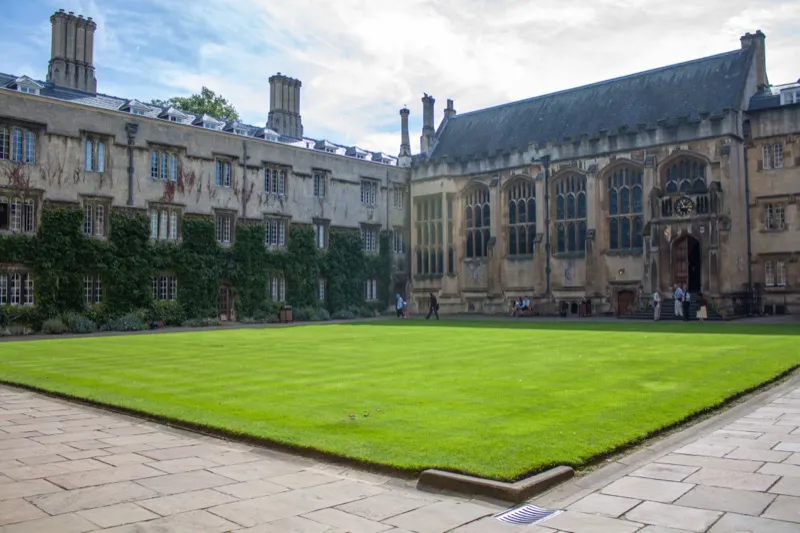
1. Exeter College — Turl Street
Tolkien came up to Exeter in October 1911, initially read classics, switched to English language and literature in 1913, and graduated in 1915 — Wikipedia's wording. He served in the First World War immediately afterwards.
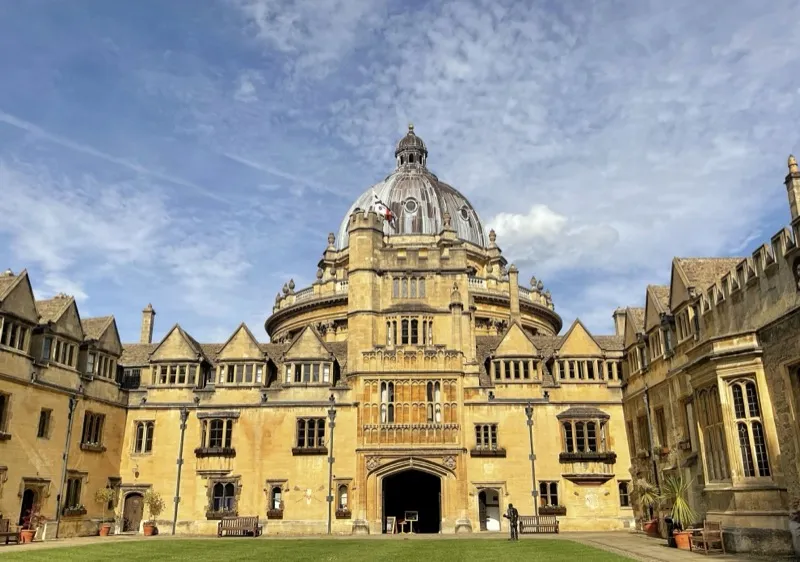
2. Pembroke College — Pembroke Square, 5 minutes south
In October 1925 Tolkien returned to Oxford as Rawlinson and Bosworth Professor of Anglo-Saxon, with a fellowship at Pembroke. He held the chair until 1945. According to Wikipedia, The Hobbit and the first two volumes of The Lord of the Rings were written during this period.
3. Merton College — Merton Street, 5 minutes east
In 1945 he moved to Merton, where he was Merton Professor of English Language and Literature until retirement in 1959.
4. The Botanic Garden — Tolkien's Tree — Rose Lane, 5 minutes south of Merton
In the back of the garden once stood a Pinus nigra (Austrian pine) under which, Wikipedia records, Tolkien "often spent his time at the garden reposing". The tree was removed in 2014 after limbs fell. Visitors still come to the spot.
5. Tolkien Memorial Bench (University Parks) — University Parks, 15 minutes north (along the Cherwell, south-east end of the Parks)
A wooden bench with a brass plaque "IN MEMORY OF J·R·R·TOLKIEN 1892–1973", dedicated by the Tolkien Centenary Conference in 1992. Two trees alongside represent Telperion and Laurelin, the Two Trees of Valinor in The Silmarillion. Quieter and less-signposted than the Botanic Garden tree, but the formal Oxford memorial.
6. The Eagle and Child — St Giles', 12 minutes south-west of the Parks
The pub the Inklings — Tolkien, C.S. Lewis, Charles Williams, Owen Barfield, Warren Lewis, Christopher Tolkien — used for Tuesday-morning meetings. The Wikipedia article on the Inklings is direct: "Tuesday mornings at The Eagle and Child pub in Oxford."
7. The Lamb & Flag — directly opposite, across St Giles'
A piece of Oxford tradition holds that the Inklings later switched to the Lamb & Flag when the Eagle and Child's back room got too noisy. The story isn't in the Wikipedia Inklings article and we haven't traced it to a primary source, so it sits here as a traditional stop on the pilgrimage rather than a documented meeting place.
Wolvercote
8. Wolvercote Cemetery — Banbury Road, 50 minutes' walk north of the city centre, or take the 6/7 bus from St Giles'
Tolkien and his wife Edith are buried in the Roman Catholic section. Their shared headstone is inscribed with the names "Beren" (J.R.R.) and "Lúthien" (Edith) from The Silmarillion — the closing point of the Oxford pilgrimage.
Practical notes
- Distance: city-centre half about 2 km; full circuit including Wolvercote about 9 km
- Time: city-centre half 90 minutes; full circuit 4 hours including Wolvercote bus, allowing time at the grave
- Best done: in two sittings — the city centre on one afternoon, Wolvercote on another (use the 6/7 bus from St Giles')
- What is NOT included here: The Kilns (C.S. Lewis's house in Headington Quarry) is on the same Inklings map but is properly its own pilgrimage — see the C.S. Lewis page
Nearby
Within a few minutes' walk